One Block, Three Stops: A Slow Walk for Noticing Small Changes
A one-block, three-stop walk shows how position changes a familiar street scene, helping you notice shifts in scale, overlap and what holds your gaze.
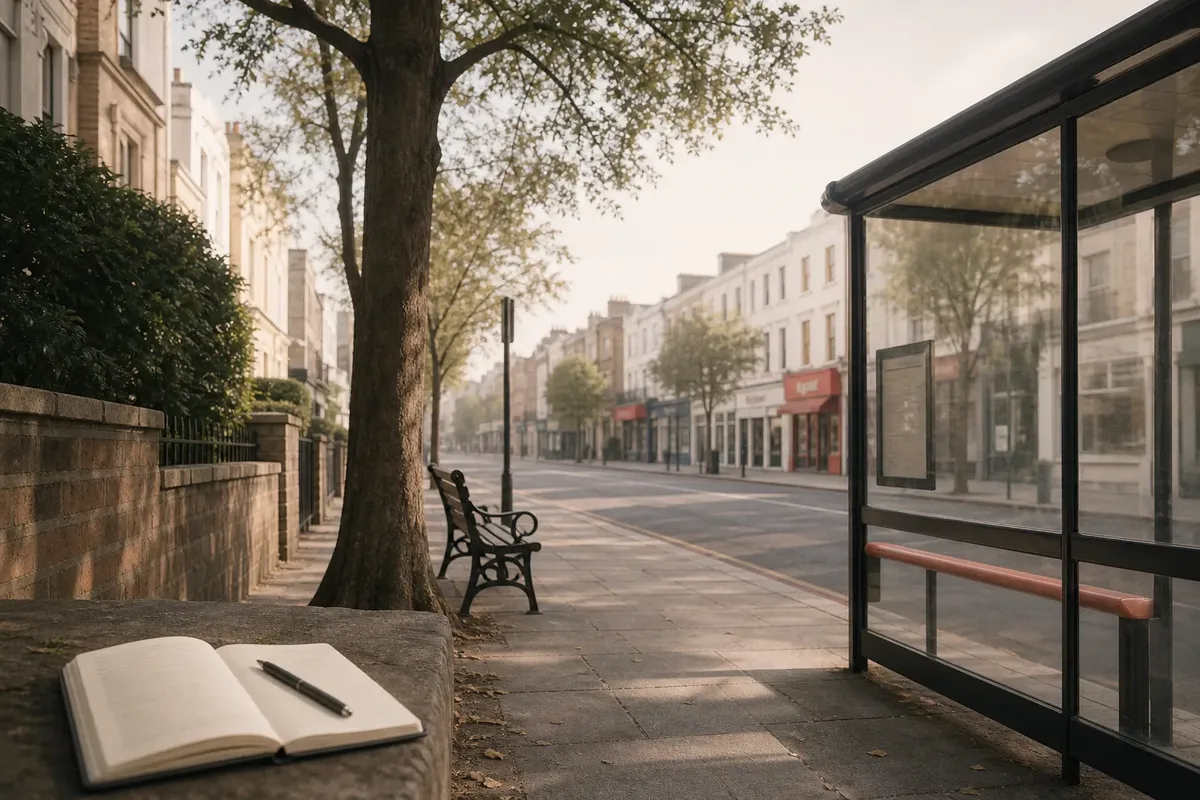
The common mistake on a familiar walk is to assume the street will look much the same from end to end; the cost is that the route becomes a blur. A one-block, three-stop walk gives you a simple way to notice how position changes a familiar street scene. Rather than hunting for details to collect, let each stopping place alter what feels near, prominent or peripheral.
Choose a short route
Pick a familiar block with a clear, safe walking space and three distinct places where you can pause without blocking a doorway or pavement. A bench, a tree and a bus shelter might work, provided each is easy to recognise and the route between them is suitable.
Before setting off, make three spaces in a pocket notebook or notes app, one for each stop. Use the same prompts at each place: what is nearest, what draws your gaze, and what sits at the edge of your view. These are not clues to solve. They are a way to notice how the scene is organised from different positions.
- Check whether the pavement is clear and comfortable to walk along; if it is, use the block, but if it is crowded or obstructed, choose another route.
- Check whether each marker is easy to identify; if it is, keep it, but if two places could be confused, choose a more distinctive marker.
- Check whether you can pause without blocking other people; if you can, use that spot, but if not, move the stop to a nearby safe place.
- Check whether making notes will distract you; if a notebook or phone is manageable, bring it, but if it would take your attention from the route, remember the prompts and write them down afterwards.
- Check whether the light, weather and level of activity make the walk comfortable and safe; if conditions are suitable, go ahead, but if not, choose another time or route.
- Check whether the three stops offer visibly different positions; if they do, keep them, but if two views seem almost the same, move one marker farther along the block.
Walk at a pace that leaves room to stop. Give yourself enough time to look without lingering where others need to pass.
Use position as a lens
At the first stop, look towards the nearest surface, then across the middle distance and towards the far end of the block. Note what takes up space and what recedes. Repeat the same sequence at the next two places, without trying to make each view produce a new discovery.
Keep observations concrete. “The red shop sign sits above the pavement at the left edge” describes a view. “The sign feels louder from here” describes your response to it; that can be worth noting too, but it is a different kind of observation. Separating the two helps you see how a scene appears without insisting that your impression is the scene itself.
Say you start beside a low brick wall, with the pavement filling much of the foreground and a tree beyond it. At the second stop, beside the tree, its branches occupy more of the upper view and the wall narrows to a strip. At the third, near a bus shelter, reflections in the glass partly cover the tree. The notes show how the same block changes in your view as you move; none of the three positions needs to count as the correct one.
Notice what falls away
After the third stop, read the notes in order. Look for changes in scale, overlap and distance: a railing might conceal a doorway from one position, while a building edge makes the tree seem less isolated from another. The useful shift is not simply that something new appears. Something else may become less prominent or disappear from view.
Each position has limits. From pavement level, a roofline may be hard to see; a tree or passing vehicle may interrupt the view. You do not need to compensate for every omission. Treating each viewpoint as partial makes it easier to compare them without turning the walk into a search for a complete picture.
If you return another day, keep the same markers when you want to compare positions. Note broad conditions, such as bright or overcast light, and any obvious change in activity. A later view is another moment on the same block, not a final account of it.
What changes between stops?
Can sound belong in the notes?
Yes. Note whether a sound seems close or distant at each stop, using a plain description such as a brief rattle or steady hum. If its source is unclear, leave it unnamed rather than guessing.
What if the views seem alike?
Look at the foreground and outer edges, where a small change in overlap or distance may be easier to notice. If the views still seem alike, record that; the comparison does not need to produce a striking difference.
Should I return in different conditions?
You can revisit if the route remains safe and comfortable. Keep the same stopping places to compare position, and note broad conditions so you can distinguish a change in light or activity from a change in viewpoint.
What if there is nowhere to stop?
Do not pause where you would obstruct others or put yourself at risk. Continue to a suitable place and write down a brief note there, or choose a route with safer stopping points.
Keep the view provisional
At the end of the walk, your notes may show that the tree holds your gaze from one position while the shopfront stands out from another. That is a description of these particular stops, not a rule about the street. Keeping the claim small leaves room for another walk to look different.
A one-block, three-stop walk works best when each note remains tied to where you stood. Use the same prompts, notice what moves to the foreground or edge, and let the next viewpoint change the balance rather than settle it.
Another angle
The Doorway View: Why a Room Changes from the Threshold
A doorway view can make a familiar room seem newly arranged; notice how light, memory and…
A Quiet Corner or a Window Seat? Choosing a Place to Read
Choose a quiet corner or window seat for reading by matching the book and your purpose…